
Grand Worldview Theories
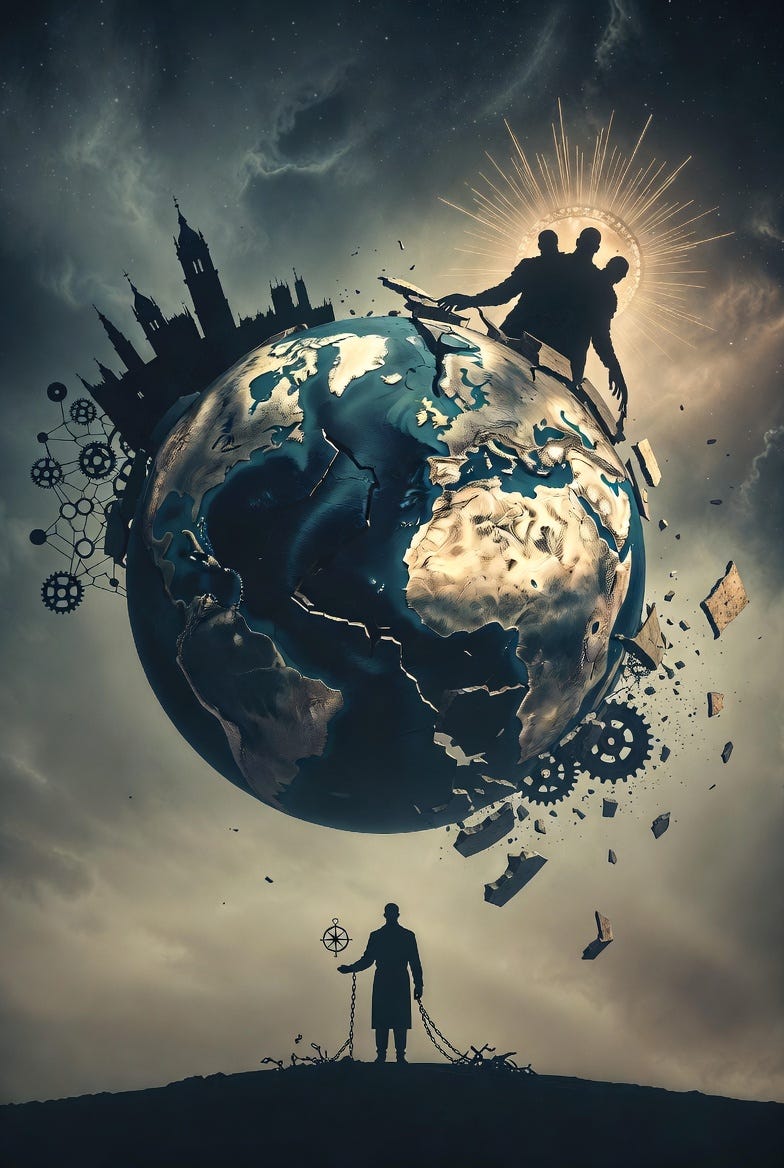
Compelling Maps of a Fracturing World

Amid the endless barrage of mainstream propaganda and fog-of-war distractions, alternative narratives regularly emerge attempting to explain what is truly unfolding in the world.
Many of these worldview perspectives deserve the “conspiracy theory” label. Unfortunately, clickbait, grift, and deception abound.
Yet other heterodox (alternative) narratives related to the COVID-19 controversies in 2020 and the Epstein files have proven more accurate than official accounts, even though significant evidence remains obscured.
When evaluating these narratives, it is essential to focus on primary sources, objective facts, and the issuer’s incentives and motivations.
In this essay, I explore three rather compelling grand theories of the changing world order.
Each is impressive in its own way. That’s what makes them convincing.
In my quest for truth, I have studied them closely over the past several years.
Here is a brief introductory overview of my three favorite theories and the authors behind them.
(I will go into more detail on each in the section that follows.)
1. ARC Alliance and the British Remnant
Author Tom Luongo, a former chemist-turned-geopolitical analyst with Austrian School and libertarian roots who has become a strong Trump supporter, casts the City of London and lingering British imperial elites as central villains.
His narratives highlight a battle for the new world order involving America, Russia, and China, the centerpiece of his “ARC” trinity of emerging multipolar regional powers.
2. MIC/FIC/TIC Coordination and Political Theater
Author: Simon Dixon, an early Bitcoin adopter and seasoned finance professional, views nation-states and politicians as actors largely controlled by, and subordinate to, transnational corporate interests.
These are the Military-Industrial Complex (MIC), Financial-Industrial Complex (FIC), and Technical-Industrial Complex (TIC), which drive global dominance through money, force, and technology.
3. Sovereign Alliance and the Golden Age
Author: Steven Kelliher (“Burning Bright”), a former kickboxer, sports writer, and storyteller turned political commentator aligned with Q-adjacent circles, presents a coordinated Sovereign Alliance—centered on America, Russia, and China—as a force working to counter globalism and shape a new golden age.
Now that we’re done with the brief introductions, let’s dive a bit deeper into the main course for each of these masterworks.
Luongo’s ARC Alliance
Luongo’s framework and narratives center on factional struggles in which the City of London and the “British Remnant”—old imperial elites clinging to influence—act as persistent manipulators, employing divide-and-rule tactics.
They triangulate between powers like the US and the EU/Davos for control.
The ARC (America, Russia, China) represents emerging hemispheric influencers challenging the post-WWII order.
Brexit, the UK’s economic decline, and broader chaos provide evidence of sabotage and elite indifference toward native populations.
Strengths:
Tom’s narrative excels at tracking real incentives—currency wars, manufactured uncertainty post-Brexit, debt traps, and how elites prioritize power over people.
It aligns with observable patterns of British/European maneuvering and monetary realism.
Luongo’s background brings a data-driven, Austrian-flavored lens that cuts through surface narratives.
Critique:
While well connected to real capital flows and historical patterns, Luongo’s framework sometimes feels scattered and relies heavily on a grand unifying “Remnant” archetype, which risks oversimplification.
His enthusiastic shift toward Trump and MAGA cheerleading appears to introduce tension with earlier libertarian priors, potentially reflecting audience capture or patriotic commitment more than pure principle.
No theory is immune to the analyst’s personal bias or need to be right.
On Ukraine and Russia:
Luongo sees the conflict as partly UK/Davos-driven to maintain influence and prevent Russia-China alignment, fitting his triangulation thesis—another chapter in imperial remnants stirring chaos rather than a simple good-vs-evil story.
On Israel and Iran:
Luongo views the dynamics as less about Israel dictating US policy and more about overlapping (but not identical) incentives amid old colonial legacies. Iran serves as a node of chaos exploited by British/European interests; US actions reflect broader efforts to deny nuclear capabilities and reshape energy flows, not subservience to any single actor.
Veracity:
7/10. Strong on mechanics and historical patterns, but the grand factionalism and personal pivot warrant caution. Useful map, not gospel.
Further Exploration:
For readers interested in learning more about Luongo’s ideas directly, you can take a dip into a recent podcast interview titled: EU & British Empires Collapsing.
Dixon’s MIC, FIC, TIC Coordination
Dixon argues that real power lies above governments in interlocking transnational complexes: the MIC profits from conflict and enforcement, the FIC dominates through debt, capital flows, and asset management (BlackRock, BIS, etc.), and the TIC builds surveillance and control grids through technology and AI.
Politicians are subordinates; crises serve to concentrate wealth and facilitate managed transitions toward a growing multipolarity.
Self-custodied Bitcoin and parallel systems offer the main escape and hope for retaining personal wealth and freedoms.
Strengths:
The model is complex yet strikingly coherent, highlighting how money, the military, and technology reinforce one another through incentives, nation-state capture, and principal-agent failures.
It explains asset stripping, petrodollar strains, and why governments often seem to act against their people’s will. (Principal-agent failure.)
Dixon’s finance experience adds measurable credibility to the flows analysis.
Critique:
Simon’s narratives lean too heavily on the grand unification of monied interests versus the nation-states’ sovereignty. His conclusions seem marginally overconfident and preordained, including an elaborate web of organic coordination that borders on the unfalsifiable—tweaks to the ongoing narrative can absorb new events and developments.
His heavy emphasis on Bitcoin self-custody as the solution reflects early-adopter bias and a plausible drive to be proven right.
The high level of dynamic complexity makes it hard to swallow whole, even if it avoids naming a single secret cabal.
Regarding Ukraine and Russia:
Dixon frames the war as part of a complex engineered capital rotation, debt dynamics, and a shift away from old petrodollar structures—another managed move in the multipolar transition, with Bitcoin sovereignty as a form of resistance.
On Israel and Iran:
Dixon interprets escalations as tools for the complexes to reset energy flows, test new technologies, and advance asset redistribution in a managed multipolar shift, with FIC/TIC elements ultimately benefiting from instability regardless of mainstream narratives.
Veracity:
8/10. Extremely insightful on systemic incentives, interconnectedness, and historical evolution, but Simon’s Bitcoin-focused prescriptive elements feel somewhat self-serving. His valuable diagnostics could use a tad more seasoning on the grand architecture and a bit less on-the-fly curve-fitting.
Further Exploration:
For readers interested in learning more about Dixon’s ideas directly, you can take a dip into a recent podcast interview titled: Dismantling the US Empire: Capital Flows, Multipolarity, and Pakistan’s Role in West Asia.
Burning Bright’s Sovereign Alliance Theory
This skillfully crafted narrative posits the emergence of a decentralized Sovereign Alliance—a core trinity of America, Russia, and China, led by Trump, Putin, and Xi—as the architects of a post-globalist golden era. (His framing shares surface similarities with Luongo’s ARC but diverges sharply in tone and metaphysics.)
It stands against collectivism and the waning rules-based international order, favoring cooperative competition, sovereignty, and renewal through a controlled demolition of the old system.
Narrative and actual events weave into an epic, often spiritual framing.
Strengths:
The prose is captivating and compelling, making complex ideas entertaining and addictive.
It integrates real events into a hopeful, unifying story that resonates with patriotic and anti-globalist instincts.
Kelliher’s storytelling talent shines in building his audience’s allegiance to patriotic worldviews and triumphant (against all odds) outcomes.
Critique:
It leans heavily on Q-Anon-adjacent themes and grand unification, projecting a sense of predestined coordination that can read as wishful fantasy.
While intelligent and masterfully articulated, his seductive narrative style risks confirmation bias for lay audiences seeking meaning over messy realism. After extended exposure, the pattern feels optimized for engagement.
On Ukraine and Russia:
Burning Bright often portrays it as scripted theater or as controlled elements within the broader Sovereign plan—part of tearing down the old guard without triggering a direct great-power war, aligning with the alliance’s “righteous” convergence.
On Israel and Iran:
The theory tends to frame conflicts as managed spectacles or pressure points that ultimately serve the Sovereign Alliance’s convergence, exposing weaknesses in the old globalist order while avoiding all-out escalation that would derail multipolar renewal.
Veracity:
6/10. Entertaining and weaves real threads, but the predestined and spiritual overlays tilt toward fantasy—compelling storytelling, weaker as a literal blueprint.
Further Exploration:
For readers interested in learning more about Burning Bright’s ideas directly, you can take a gander at his marvelous archived narrative style in a mega-post titled: The Sovereign Alliance: Breakers of the System—builders of the Golden Age.
Having surveyed these three compelling, yet ultimately over-extended narratives (some more than others), the discerning reader might ask: if none of these grand scripts hold up as literal blueprints, why do they all feel so intuitively resonant?
The answer lies not in the remnants of past Empires, organically coordinated complexes of transnational corporate oligarchs, or any predestined, golden-age, sovereign convergence, but in the chaotic, uncoordinated, unpredictable, and harsh reality of structural decay and great-power dynamics.
Each theorist has correctly identified a genuine fracture—the decline of Western institutional credibility, the capture of state machinery by financial and technological elites, and the palpable shift toward a multipolar landscape.
Where they stray is in imposing a directing intelligence upon these fractures.
My preferred lens dispenses with the scriptwriters altogether, favoring instead a pragmatic synthesis grounded in great-power realism, history, and institutional inertia.
Let’s call this framework the ‘True Jigsaw’—not because it completes the picture, but because it acknowledges the jagged, imperfect pieces of international affairs as they truly are: driven by self-preservation, resource competition, and the mundane, unglamorous corrosion of aging empires.
The True Jigsaw
Despite my huge respect for all three creators—their talents, backgrounds, and insights—I ground my view in Mearsheimer-style great power realism alongside pragmatic syntheses like those articulated in Peter Underwood’s recent Substack titled “Fragile Truce; MoU; US Suez Moment; Can Israel be Contained.“
The US is an aging, corrupt, heavily indebted empire struggling to maintain hegemony while failing at home.
Similar rot afflicts much of the West, including the City of London.
Russia, despite its own corruption and dictatorship, at least shows some focus on its population and maintaining a self-sustaining domestic industrial capacity.
China leverages its massive manufacturing advantages, even as it manages the challenges of its unique brand of corruption and totalitarianism.
Luongo and, especially, Dixon offer useful coincident indicators that fit within this lens.
Burning Bright’s narrative is more wishful, though skillfully constructed.
My take, the True Jigsaw, is in concurrence, favoring Occam’s razor: no grand heroes or inevitable golden alliances—just self-interested powers navigating multipolar birth pangs since the 2008 great financial crisis.
Corruption is universal; dominance and survival drive behavior. Principal-agent capture (in which elites pursue their own interests rather than those of those they represent) is the norm. The convulsions we witness are the old order’s decline, not a scripted conspiracy or divine plan.
On Ukraine and Russia:
These conflicts exemplify classic great-power competition and proxy conflicts amid imperial decline and resource maneuvering. They reflect Russia’s defensive industrial resilience against Western overreach rather than grand alliances or inevitable triumphs of any single complex or remnant faction.
On Israel and Iran:
Tensions here highlight proxy dynamics, energy chokepoints, and the limits of US hegemony in a fracturing order. They stem from realist security dilemmas and regional power plays, not master narratives of hidden coordination or predestined convergence—another symptom of multipolar birth pangs and elite capture across the board.
Veracity:
9/10. This fourth worldview is strongly grounded in observable state capabilities, historical imperial patterns, and incentive structures. It avoids over-unification while acknowledging universal corruption and messiness—making it the most robust and parsimonious framework among the three we examined.
Self-Critique:
The framework’s chief blind spot is its state-centric focus. By prioritizing great powers and traditional nation-state metrics, it risks underestimating the non-state forces Dixon highlights—algorithmic surveillance, decentralized finance, and information warfare. These can create emergent coordination effects resembling a conspiracy without a central director.
Still a map—subject to new evidence and second-order surprises—but the most defensible starting point among those examined.
Further Exploration:
For readers interested in learning more about Mearsheimer’s ideas directly, you can take a dip into a recent podcast interview titled: The Return of Great-Power Politics.
Conclusion
The three theories surveyed illuminate aspects of a fracturing world, but each ultimately falls short of providing a complete explanation. They excel at exposing institutional deception and elite incentives, yet falter under the weight of their own grand unifying narrative, personal biases, and narrative allure.
The clearest path forward lies in radical skepticism toward all centralized power—government, finance, tech, or “alliances”—paired with realist attention to capabilities, resources, and second-order effects.
Follow the money, the industrial capacity, the debt, and the corpses of past narratives.
Arm yourself with primary evidence, sound principles, and decentralized resilience.
In the end, there are no saviors or perfectly coordinated white hats—only individuals and nations pursuing their interests amid the chaos of human nature at scale.
The historic shift in the world order demands clear eyes, not comforting epics.
Truth emerges not from any single theory, but from relentlessly questioning them all.